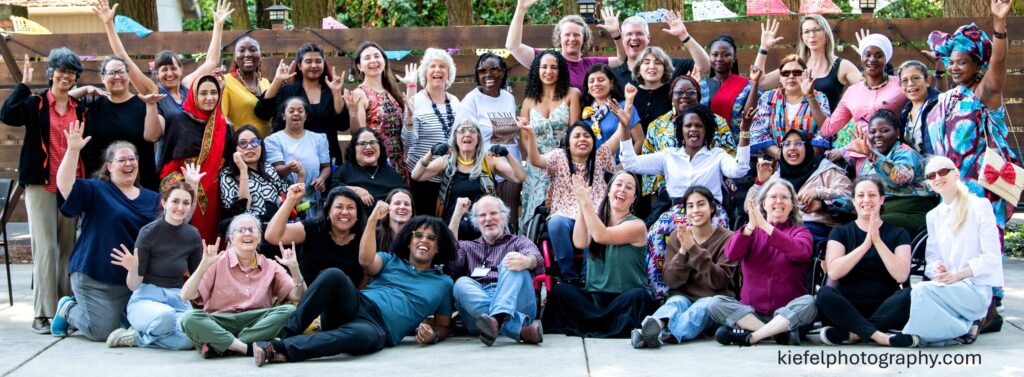
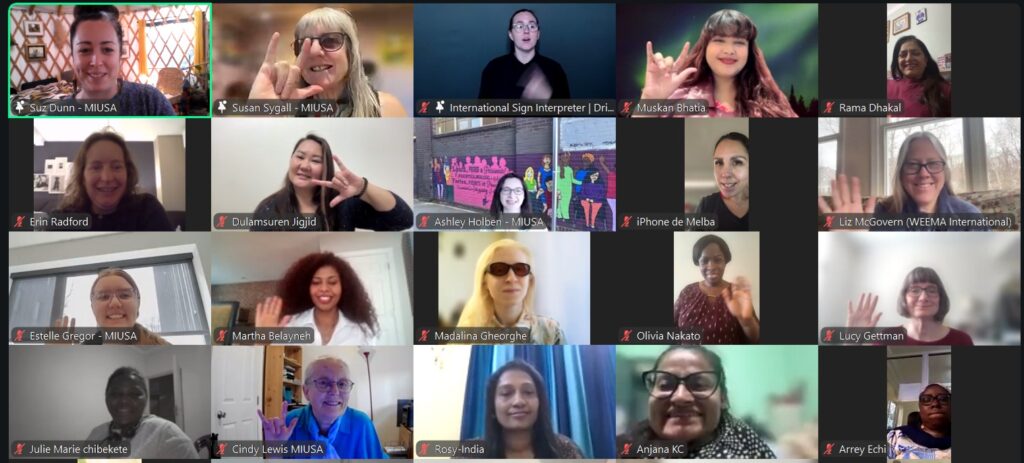
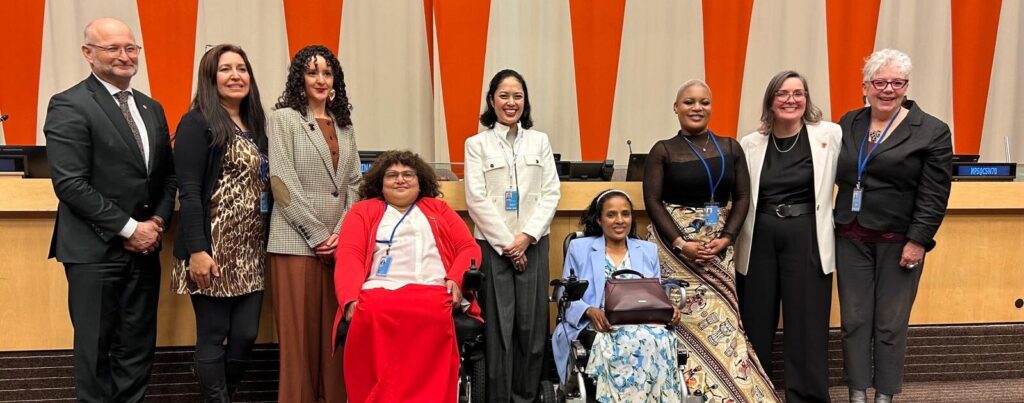
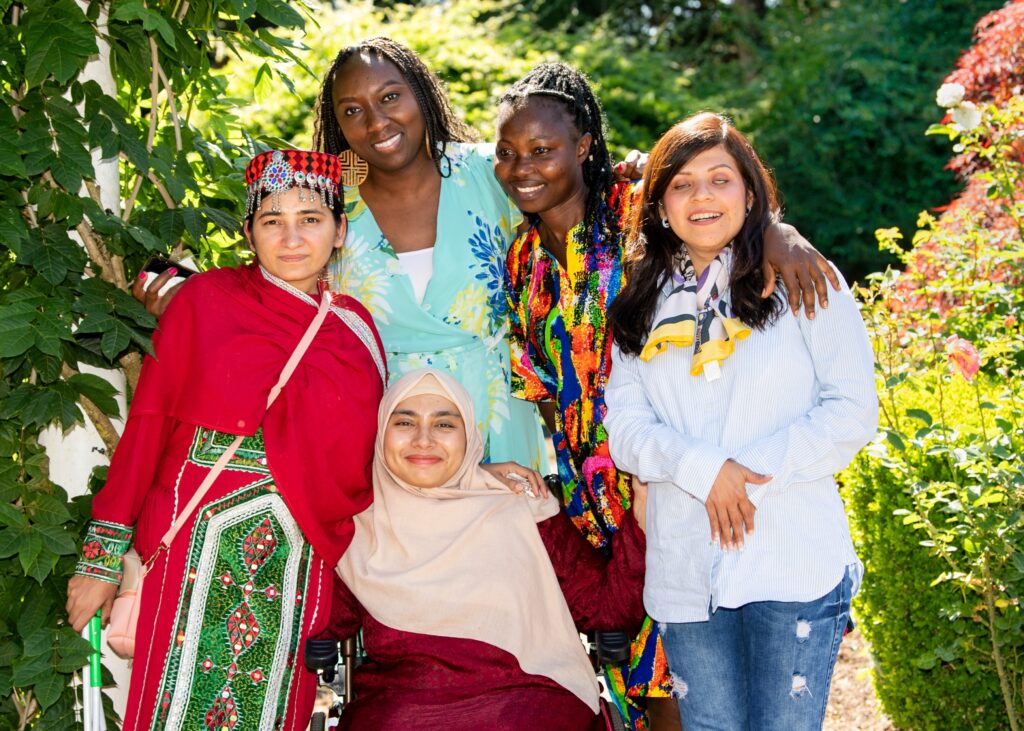
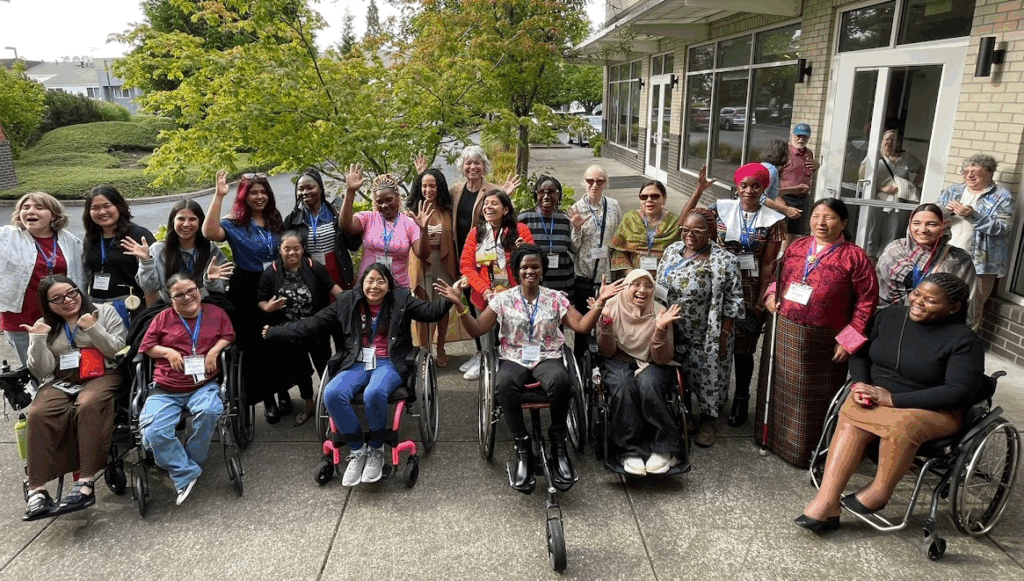
One objective of the MIUSA Global Fellowship is to provide space for Fellows – all high-level leaders with disabilities – to connect with their peers from around the world to share experiences and strategies for activism. Our inaugural cohort of Fellows expressed that among their top priorities is creating strong, enforceable policies and legislation to expand the human rights of people with disabilities in their countries:
“I joined today because I believe that the true test of disability legislation is whether it moves rights from paper into the everyday lives of persons with disabilities.” – Miyeon Kim from the Republic of Korea, Chair of the United Nations Committee on the Rights of Persons with Disabilities.
“I would like to further deepen my knowledge of disability policy and legislation through learning from other Fellows and external experts. In particular, I am interested in understanding how disability laws and policies are effectively implemented in practice across different contexts.” – Dulamsuren Jigjid from Mongolia, Executive Director of the Culture Centre of the Deaf
We were therefore pleased to convene the MIUSA Global Fellows for a dynamic virtual session on Advancing Disability Policy and Legislation.
MIUSA CEO Susan Sygall opened the session by reiterating principles for achieving disability rights, including:
With these principles laying the foundation, Susan invited the Fellows to use this session to share the specific experiences and strategies they have used to pass disability-related legislation in their countries at local, provincial, state, national, and international levels. How did their laws get passed, and what makes those laws enforceable? What still needs to be done? What can we learn from the work activists are doing in other countries?
Susan also elaborated on the other primary purpose of this session, which is to create connections:
“We hope to spark connections between Fellows, and between our Fellows and our resource experts. Several Fellows have told us about an experience in the U.S. that sparked an idea to take back to their countries. That’s really important, because sometimes you can’t dream something unless you’ve experienced it first-hand, whether it’s the opportunity to ride accessible public buses or to observe people with disabilities fully participating at universities.”
During the session, and building on survey responses collected from Fellows in advance, the discussion focused on three questions:
Fellows who have had success passing disability rights legislation in their countries summarized key strategies:
Muhammad Shafiq ur Rehman from Pakistan, on enacting a comprehensive rights-based disability law for the Province of Punjab:
Milestone worked with MIUSA to apply for funding to draft a comprehensive rights-based disability law for the Province of Punjab. Although our project proposal was rejected by the donor, in developing the proposal, we learned about the process of building a rights-based legal framework.
Rather than waiting for another funded project, Milestone voluntarily offered our technical support to draft the law and facilitate the legislative process. We believed that meaningful change required commitment more than resources. We found important government allies, such as the Director General of the Social Welfare Department, who, having grown up with a parent with a disability, already possessed a deep understanding of disability rights and inclusion. We sought legal guidance from a trusted friend in the Ministry of Law and Justice, who reviewed the initial draft and provided valuable advice to the legal foundation of the draft. We brought together disability leaders, legal experts, government officials, and others to refine the draft law and build broad ownership of the proposed legislation.
Our efforts were successful: Punjab enacted a modern rights-based disability law! We continued working on the Business Rules necessary for its implementation.
This journey taught us that real change does not always begin with funding. Sometimes it begins with knowledge, trusted relationships, volunteerism, strategic thinking, and the determination to turn a vision into reality.
Karine Grigoryan from Armenia, on passing a comprehensive rights-based disability law in Armenia:
I believe we were successful because we built a broad and diverse coalition, not only among cross-disability organizations, but also with women’s rights groups, LGBTQI+ organizations, and other human rights CSOs. This helped show that disability rights are part of a wider human rights agenda.
The second key strategy was strong collaboration with international organizations and decision-makers. We also tried to identify and engage decision-makers who had a personal or professional connection to disability, as they were often more open to understanding the urgency and importance of the reform.
Passing a law is just one part of the equation. Although many countries and regions have successfully passed disability legislation, these laws have often not been implemented. MIUSA Global Fellows described what needs to be in place for laws to be enforced:
Ekaete Judith Umoh from Nigeria, on translating the provisions of Nigeria’s Disability Anti-discrimination Law from paper to meaningful action:
When the law was passed, it was with the establishment of the National Commission for Persons with Disabilities (NCPD). They gave five years for people to get used to the law, and then after these five years, the law would be enforceable.
On the part of civil society, we needed to get a system in place to monitor the implementation of the law and formed a task force on accessibility. The NCPD has now established the “Compliance and Enforcement Department” to drive the implementation of the law. It is the mandate of the commission to develop accountability mechanisms.
One strategy was developing an accountability mechanism to track how the public, the government, and everyone else is responding to the law. The Compliance and Enforcement Department formed the Technical Working Group and Inter-Ministerial Accessibility Enforcement Task Force. Its mandate is to monitor what private sectors, government, and others are doing to ensure that they have environmental accessibility, and that people with disabilities are able to get access to public areas.
Mila Guedes from Brazil, on the Brazilian Inclusion Law, which was enacted over a decade ago yet still lacks regulation of some of its provisions:
From my experience working with women with disabilities’ rights in Brazil, I’ve learned that passing a law is only the first step. Ensuring its implementation requires continuous advocacy, collaboration with governments — especially with parliament, and the active participation of organizations of persons with disabilities.
First, the governments must allocate financial and human resources to turn legal commitments into concrete public policies and services. Second, there must be continuous training of public officials and services providers. These must be done together with strong monitoring and accountability mechanisms.
Without these elements, even the best legislation may remain on paper.
Even if a law is not currently being implemented, or if it’s a “work in progress,” disability rights activists are nonetheless using laws to make changes that benefit the people with disabilities.
Senator Asia Yaghi of the Jordanian Senate affirms that her top priority is establishing the concept of the rights of persons with disabilities as inherent and guaranteed legal rights, not merely acts of charity. In line with this approach, the Senate formed a specialized committee for persons with disabilities. Its mandate includes activating constitutional oversight mechanisms to effectively monitor and implement the rights of persons with disabilities within the framework defined by the Jordanian Constitution.
Anjana K.C. from Nepal and her fellow disability rights activists have successfully used the law to advocate with the government to allocate funds for programs that create real change in the everyday lives of people with disabilities.
Jenny Chinchilla from El Salvador illustrated how crucial a timely opportunity can be in driving change. Jenny explained that, as her country has gone through different government administrations—some more open to citizen participation in policymaking than others—leaders from various organizations of persons with disabilities have continued to mobilize, informing and raising awareness among government officials across different sectors while also advocating for legislation and for the participation of persons with disabilities in decision-making processes.
“For many years, organizations of persons with disabilities in civil society worked to develop and advocate for a disability inclusion law based on the Convention on the Rights of Persons with Disabilities (CRPD). The law was ultimately approved by the current presidential and legislative administration, marking a significant milestone for the rights of persons with disabilities in the country.
“Today, the main challenge is to restore collaborative partnerships between public institutions and organizations of persons with disabilities to uphold our guiding principle: ‘Nothing about persons with disabilities without persons with disabilities.’ I usually add, ‘without the full participation of women with disabilities.’”
During the virtual session, Global Fellows were joined by resource people from the U.S. who are internationally recognized leaders in disability rights and who have championed the Americans with Disabilities Act (ADA) in different ways. These experts provided their own insights based on their experiences having worked on legislation in the United States and in other countries.
John Wodatch, a disability rights attorney, is one of the drafters of the Americans with Disabilities Act and led the U.S. Department of Justice’s office in charge of enforcing the ADA. John reminded us that passing disability rights legislation is not achieved overnight; rather, it is a long process that can take years and even decades:
“You cannot get discouraged. You have to keep your eyes on what you’re doing and keep working at it. It keeps your coalition from being discouraged and disappearing if they have activities that they can do that build toward the goal.”
Arlene Mayerson, former Directing Attorney of Disability Rights Education & Defense Fund (DREDF), is one of the nation’s leading experts in disability rights law and devoted her career exclusively to disability rights practice. Arlene believes that some of the lessons learned from passing the ADA in the U.S. can be valuable to activists in other countries and cultural contexts:
“Strategy, strategy, strategy! Always know what you’re going to do next.”
For example:
“One thing that we relied on a lot in passing the ADA was including some viable economic arguments to help show that it’s a matter of dollar and cents: that instead of being tax users, [people with disabilities] could be taxpayers and be a resource for the country.”
Maria Town, President and CEO of the American Association of People with Disabilities (AAPD), offered the following sage advice to the Fellows about hope:
“I would like to remind everyone that hope is a discipline. It is not this abstract thing. It is a discipline that we all have to embrace, and whether that is through optimism or strategy or anger, no matter what happens or how long it takes, we have to build a practice and discipline of hope within ourselves so that we can do so within the communities around us, and all of you are very disciplined in your hopefulness.”
We were also joined by Howard Rosenblum, founder and CEO of Deaf Equality, which conducts litigation and consulting on policy and regulations in countries throughout the world. Howard has directed impact court cases and changes in policy that have increased access in employment, education, and communications across government and private sector services.
Howard’s colleague Zainab Alkebsi, Chief Policy Officer at Deaf Equality, celebrated a success story from Kenya, where she and Howard worked with Habel Ouma, a MIUSA Global Fellow, and other Deaf Kenyan leaders:
“It has been inspiring to watch Deaf Kenyan leaders and their allies successfully pass a Deaf rights bill through their national legislature. This was a wonderful example of how the disability community and legal and political advocates can work together to advance equal rights on a legislative level. Thanks to MIUSA for giving us the opportunity to be a part of this effort to collaborate with Deaf Kenyans and other leaders in reaching this amazing result. Congratulations to every one of you for all your efforts to achieve equality in your respective countries.”
Adding to these leaders’ messages of encouragement, strategy, and hope, Susan Sygall shared her own advice for staying motivated:
“When working for disability rights, you have to have righteous anger combined with joyful optimism.”
As they celebrate progress, these activists are also looking ahead to advance and strengthen their rights through policy and legislation. Top priorities and goals reported by MIUSA Global Fellows for advocacy in their countries include:
Mila, Brazil: To advance policies that promote the rights of women with disabilities in Brazil so that disability and gender perspectives are integrated into policy and legislation.
Mause, Haiti: Following the elections and the establishment of a new Parliament, to advocate for legislation that protects women and girls from conflict-related sexual violence and requires health institutions to provide survivors with a minimum package of essential services.
Asia, Jordan: To promote awareness of the legal rights of persons with disabilities and their families, and to monitor the commitment of public and private institutions to implement legislation and turn it into concrete action.
Anjana, Nepal: To ensure that province-level law is fully implemented and making change for people with disabilities.
Jenny, El Salvador: To use social media platforms to promote examples of good practices for inclusion based on this law.
Hellen, Nigeria: To advocate for a disability-inclusive budget on health and to demand a 15% allocation for persons with disabilities in economic opportunities.
Shafiq, Pakistan: To strengthen service systems used by people with disabilities and to promote social business to make the system economically sustainable.
We at MIUSA want to thank everyone who contributed their expertise, insights and questions to this virtual session on Advancing Disability Policy and Legislation, including the U.S. resource people whose work on U.S. laws have had a global ripple effect. Of course, we especially offer our thanks to the MIUSA Global Fellows, who are a powerful force of leaders changing the lives of people with disabilities around the world.
Film: Change, Not Charity: The Americans with Disabilities Act tells the emotional and dramatic story of the decades-long push for equality and accessibility that culminated in the passage of the Americans with Disabilities Act (ADA) in 1990. The video is available online for free, in English, with English or Spanish captions available, and with English audio description available
Article: 10 Principles of Disability Rights (available for download in English, Spanish, Vietnamese, and Armenian)
Short Video: “RightsNow! Changing the Everyday Lives of People with Disabilities Through the Power of Law” (in English with English captions available).
Hellen Anurika Beyioku-Alase from Nigeria shared media detailing the passage of policy requiring sign language interpretation in public hospitals in Nigeria. Hellen described the case as “a victory in the healthcare system, the first of its kind, which could benefit others”:
Cover photo: Muhammad Shafiq ur Rehman (front row, far right) gathers with other activists with and without disabilities in front of the U.S. Capitol Building in Washington, DC as part of MIUSA’s U.S./Pakistan Independent Living Exchange Program.
Sign up for our E-News