
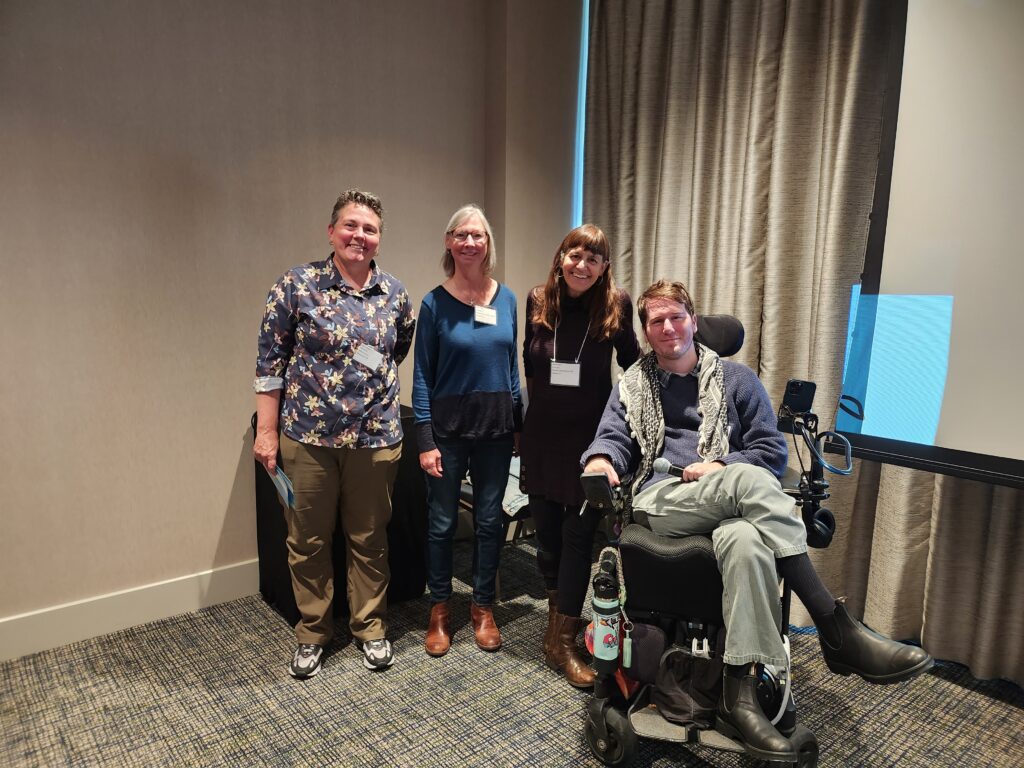
Tre’s journey to Japan began during their first week of rehab and recovery from a C5 spinal cord injury that resulted from a car accident. They learned about the Craig H. Neilsen Scholarship and tucked that information away as something to pursue. Tre had already completed a BA but was interested in continuing their education.
During those early weeks of recovery, Tre also met Laura Ridler, a recreation therapist and disability access advocate, and their partnership as co-travelers, friends, and co-conspirators began.
Tre secured the Craig H. Nielsen scholarship to pursue a certificate in public health at Portland Community College (PCC). They had the opportunity to take their final course – Community and Public Health – by enrolling in a faculty-led experience in Kyoto, Japan. They knew they’d need a personal assistant to support a study abroad experience and reached out to Laura who was quickly on-board for the ride.
Tre and Laura worked together in earnest after making the trip deposit in February until their departure in August. Laura had accompanied other powerchair riders on travel for work and pleasure so was well versed in how to pack a powerchair for flights, among the many logistics needed for a successful trip.
They used Cognitopia, a web-based software program that supports independent living, to keep them organized as they prepared for every aspect of the trip – from what to pack to power adaptors and accommodations and the many questions they needed answered. They met weekly, in person or virtually, and kept chipping away at their list. That meant taking steps to make sure Tre was comfortable with Laura providing care, including joining pre-trip doctor visits to be prepared to troubleshoot in case something did happen.
Anne Frey, study abroad coordinator at PCC, was another key partner in the preparation process. As she explained, “I followed the lead from Tre and Laura. I didn’t know how it would all work but was confident we would figure it out together and make it happen, [in part] thanks to the scholarship we had funds to work with.” Anne relied on Tre and Laura to ask for the information they would need from the site providers, such as chair turn-arounds on buses, sidewalk widths, room specs. Anne also worked with the site providers, and sought guidance and support from the Accessible Education and Disability Resources office at PCC.
So off Tre and Laura went, as prepared as they could be. The trip was just over two weeks in Kyoto, with an overnight stay to Hiroshima and many day excursions. The group included 10 other students, many of whom stayed with families, while Tre and Laura were housed at a local hotel. It was an adventure that brought a few curves balls and unexpected delights.
Accessibility in Japan looks different. While Japan does not have a comprehensive law like the ADA, a reliable working infrastructure made travel go fairly smoothly. Elevators worked and transportation staff communicated with each other so that someone was ready and waiting with a moveable ramp for the train when Tre arrived at each destination. Restrooms on the trains were accessible and dedicated pedestrian streets offered ease of navigation.
However, every stop on the group itinerary was not accessible for Tre. Nearly each day, some challenge required a pivot, change of plan, or in the worst case scenario, missing out.
Other challenges were unrelated to accessibility: the instructor for the course got COVID and had to teach remotely from a hotel; temperatures hovered around 100 degrees F and typhoons threatened. But folks did their best and made adjustments on the spot.
“It was a whirlwind – take down the chair and set it back up. Hope that it doesn’t get damaged on each flight. We prepared as much as we possibly could…neck fans, hats, masks. August in Kyoto is a rough time. But everybody did their best.”
Tre reflected that their fellow student travelers were “understanding, and [my] being on the trip with them made them notice things differently. I don’t like to be ‘a teachable moment’, but everyone was learning. Folks were checking in on me. Connecting with peers made a difference.”
Tre and Laura also worked out ways for Tre to was able to go out and have fun without the PA, with Laura standing by: “Go out for drinks and call if you need me.”
One particular highlight of the trip was a visit to the Kyoto Center for Independent Living, where being in community with other wheelchair users was a powerful feeling.
Overall, Tre loved the experience, which made Tre more confident and realize how much they are capable of.