
As told to Ashley Holben, NCDE Project Specialist
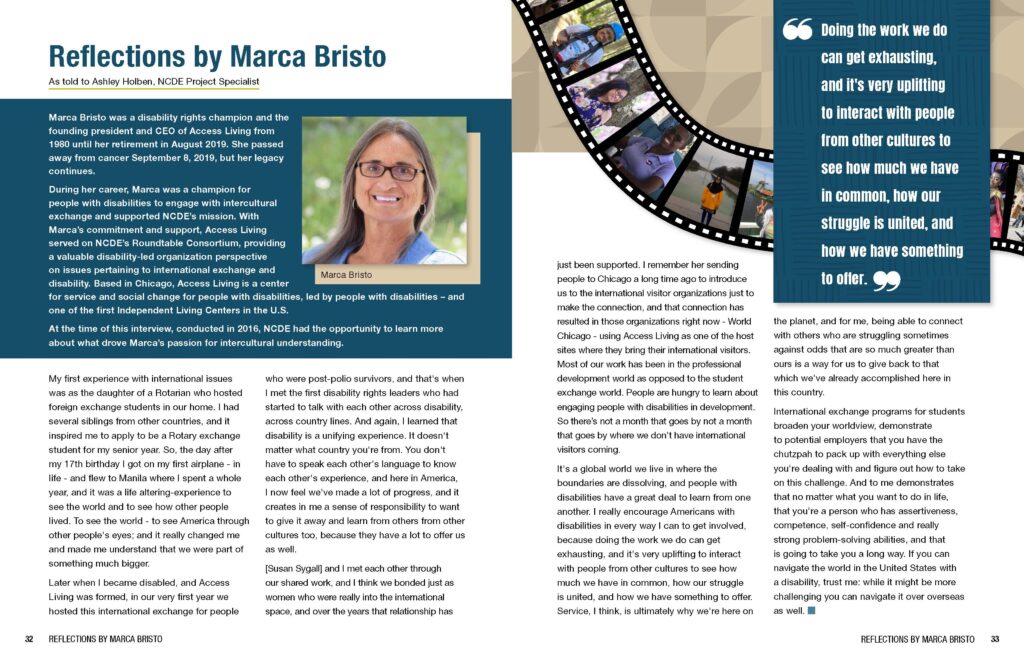
Marca Bristo was a disability rights champion and the founding president and CEO of Access Living from 1980 until her retirement in August 2019. She passed away from cancer September 8, 2019, but her legacy continues.
During her career, Marca was a champion for people with disabilities to engage with intercultural exchange and supported NCDE’s mission. With Marca’s commitment and support, Access Living served on NCDE’s Roundtable Consortium, providing a valuable disability-led organization perspective on issues pertaining to international exchange and disability. Based in Chicago, Access Living is a center for service and social change for people with disabilities, led by people with disabilities – and one of the first Independent Living Centers in the U.S.
At the time of this interview, conducted in 2016, NCDE had the opportunity to learn more about what drove Marca’s passion for intercultural understanding.
My first experience with international issues was as the daughter of a Rotarian who hosted foreign exchange students in our home. I had several siblings from other countries, and it inspired me to apply to be a Rotary exchange student for my senior year. So, the day after my 17th birthday I got on my first airplane – in life – and flew to Manila where I spent a whole year, and it was a life altering-experience to see the world and to see how other people lived. To see the world – to see America through other people’s eyes; and it really changed me and made me understand that we were part of something much bigger.
Later when I became disabled, and Access Living was formed, in our very first year we hosted this international exchange for people who were post-polio survivors, and that’s when I met the first disability rights leaders who had started to talk with each other across disability, across country lines. And again, I learned that disability is a unifying experience. It doesn’t matter what country you’re from. You don’t have to speak each other’s language to know each other’s experience, and here in America, I now feel we’ve made a lot of progress, and it creates in me a sense of responsibility to want to give it away and learn from others from other cultures too, because they have a lot to offer us as well.
[Susan Sygall] and I met each other through our shared work, and I think we bonded just as women who were really into the international space, and over the years that relationship has just been supported. I remember her sending people to Chicago a long time ago to introduce us to the international visitor organizations just to make the connection, and that connection has resulted in those organizations right now – World Chicago – using Access Living as one of the host sites where they bring their international visitors. Most of our work has been in the professional development world as opposed to the student exchange world. People are hungry to learn about engaging people with disabilities in development. So there’s not a month that goes by not a month that goes by where we don’t have international visitors coming.
It’s a global world we live in where the boundaries are dissolving, and people with disabilities have a great deal to learn from one another. I really encourage Americans with disabilities in every way I can to get involved, because doing the work we do can get exhausting, and it’s very uplifting to interact with people from other cultures to see how much we have in common, how our struggle is united, and how we have something to offer. Service, I think, is ultimately why we’re here on the planet, and for me, being able to connect with others who are struggling sometimes against odds that are so much greater than ours is a way for us to give back to that which we’ve already accomplished here in this country.
International exchange programs for students broaden your worldview, demonstrate to potential employers that you have the chutzpah to pack up with everything else you’re dealing with and figure out how to take on this challenge. And to me demonstrates that no matter what you want to do in life, that you’re a person who has assertiveness, competence, self-confidence and really strong problem-solving abilities, and that is going to take you a long way. If you can navigate the world in the United States with a disability, trust me: while it might be more challenging you can navigate it over overseas as well. ■
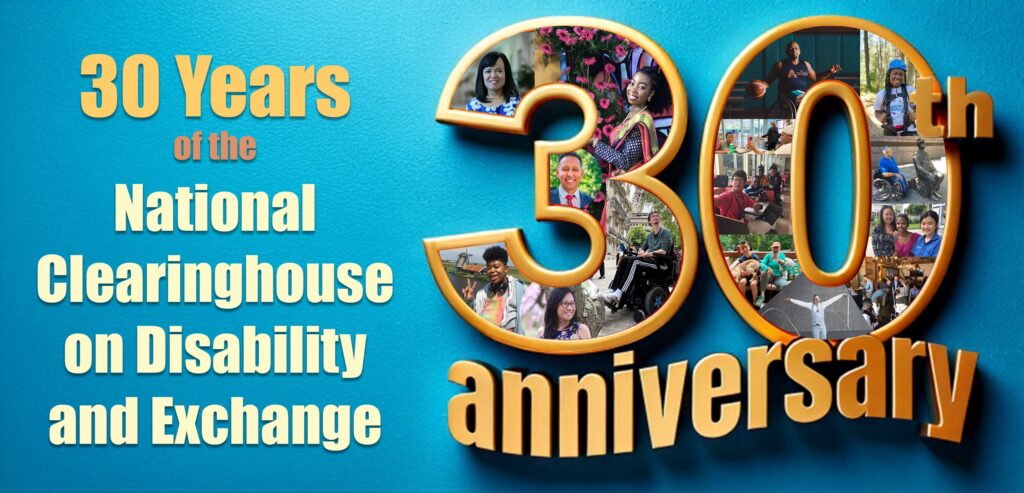
This article is part of the AWAY Journal – NCDE’s 30th Anniversary Issue