
By Ashley Holben, NCDE Project Specialist
International exchange isn’t just an individual experience. Every one person who travels represents their home community, or sometimes several communities. During their exchange, they make connections with host families, new friends, and other community members. And when they return home, the experience of having formed relationships abroad shapes their worldview in ways that continue to impact the people around them, creating ripples and returns that can be felt even years later.
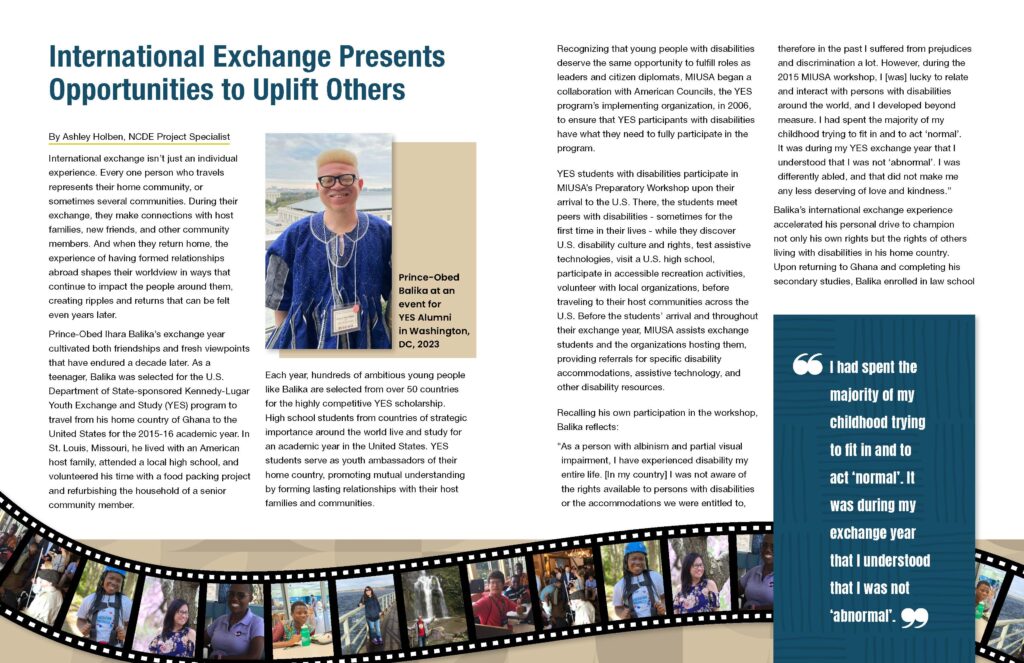
Prince-Obed Ihara Balika’s exchange year cultivated both friendships and fresh viewpoints that have endured a decade later. As a teenager, Balika was selected for the U.S. Department of State-sponsored Kennedy-Lugar Youth Exchange and Study (YES) program to travel from his home country of Ghana to the United States for the 2015-16 academic year. In St. Louis, Missouri, he lived with an American host family, attended a local high school, and volunteered his time with a food packing project and refurbishing the household of a senior community member.
Each year, hundreds of ambitious young people like Balika are selected from over 50 countries for the highly competitive YES scholarship. High school students from countries of strategic importance around the world live and study for an academic year in the United States. YES students serve as youth ambassadors of their home country, promoting mutual understanding by forming lasting relationships with their host families and communities.
Recognizing that young people with disabilities deserve the same opportunity to fulfill roles as leaders and citizen diplomats, MIUSA began a collaboration with American Councils, the YES program’s implementing organization, in 2006, to ensure that YES participants with disabilities have what they need to fully participate in the program.
YES students with disabilities participate in MIUSA’s Preparatory Workshop upon their arrival to the U.S. There, the students meet peers with disabilities – sometimes for the first time in their lives – while they discover U.S. disability culture and rights, test assistive technologies, visit a U.S. high school, participate in accessible recreation activities, volunteer with local organizations, before traveling to their host communities across the U.S. Before the students’ arrival and throughout their exchange year, MIUSA assists exchange students and the organizations hosting them, providing referrals for specific disability accommodations, assistive technology, and other disability resources.
Recalling his own participation in the workshop, Balika reflects:
“As a person with albinism and partial visual impairment, I have experienced disability my entire life. [In my country] I was not aware of the rights available to persons with disabilities or the accommodations we were entitled to, therefore in the past I suffered from prejudices and discrimination a lot. However, during the 2015 MIUSA workshop, I [was] lucky to relate and interact with persons with disabilities around the world, and I developed beyond measure. I had spent the majority of my childhood trying to fit in and to act ‘normal’. It was during my YES exchange year that I understood that I was not ‘abnormal’. I was differently abled, and that did not make me any less deserving of love and kindness.”
Balika’s international exchange experience accelerated his personal drive to champion not only his own rights but the rights of others living with disabilities in his home country. Upon returning to Ghana and completing his secondary studies, Balika enrolled in law school and began work at the National Council on Persons with Disabilities, where he assisted persons with disabilities with social and legal matters.
MIUSA and Balika reconnected many years after his days as a YES student, this time through the NCDE. Balika applied for NCDE’s Access to Exchange Externship program, which invites international exchange alumni with disabilities to promote the participation of people with disabilities in international exchange. Balika saw the externship as an opportunity to serve as an ambassador for access, citizen diplomacy, and international exchange.
For his externship project, Balika hosted a webinar session for people with disabilities in Ghana to explore the many opportunities and benefits of international exchange. He invited his fellow members of the Special Students Union of the University of Ghana and the Ghana Association of Persons with Albinism. He also tapped into his network of YES alumni in Ghana, to speak to their exchange experiences and disability accommodations that had been available to them during their exchange years.
One of these YES alumni was Joseph “PJ” Oppong, a YES alum with a physical disability, who discussed the ways in which exchange programs teach participants with disabilities independence and self-reliance. Balika himself added that, especially for people with disabilities, international exchange can instill a sense of agency and opportunities to make decisions for oneself.
The NCDE Externship emphasizes anticipating planning for audiences of people with and without different types of disabilities. Balika took this lesson to heart, ensuring that his Deaf or hard of hearing attendees would have access to captions and sign language interpreting as needed, or that blind or visually impaired attendees could access images and information in accessible formats.
“The NCDE Externship taught me how important it is to understand every individual and their disabilities in so that whatever project or activity I was leading was accessible and catered to their respective needs. This involves the media used, texts and the structure of presentations.”
The NCDE Externship reinvigorated Balika in his passion for disability rights – his rights – and to champion human rights causes in Ghana. As the secretary and subsequently the president of the YES Alumni Association in Ghana, Balika oversaw projects to benefit communities across the country, from a book drive in Nzulezu, a clothing drive at Mankessim, volunteer activities at Save Them Young Orphanage and Chosen Children’s Center, and projects to promote awareness of cervical cancer and breast cancer. One project Balika is especially proud to have helped launch is the Happy Perioding project, which aims to lessen the stigma around menstruation and to promote menstrual health and formal education among teenage girls in underprivileged communities. Through a series of training activities and seminars, Balika’s team had taught 160 young girls to make reusable sanitary pads and donated 854 disposable pads as well as 165 wet bags.
Today, at 27 years old, Balika is a final year student at the Ghana School of Law, and he is unlikely to take a break from using his experiences as a leader to uplift others anytime soon. “Through my work life and my actions, I have the ability to empower the disenfranchised and anyone living with disabilities that I meet.” ■
This article is part of the AWAY Journal – NCDE’s 30th Anniversary Issue