
By Justin Harford
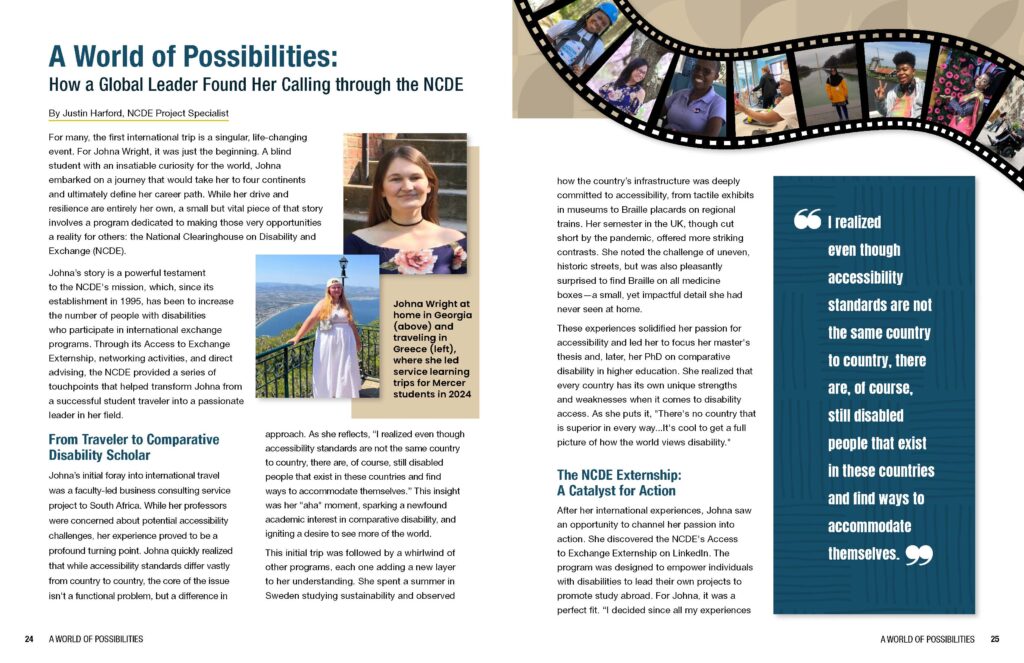
For many, the first international trip is a singular, life-changing event. For Johna Wright, it was just the beginning. A blind student with an insatiable curiosity for the world, Johna embarked on a journey that would take her to four continents and ultimately define her career path. While her drive and resilience are entirely her own, a small but vital piece of that story involves a program dedicated to making those very opportunities a reality for others: the National Clearinghouse on Disability and Exchange (NCDE).
Johna’s story is a powerful testament to the NCDE’s mission, which, since its establishment in 1995, has been to increase the number of people with disabilities who participate in international exchange programs. Through its Access to Exchange Externship, networking activities, and direct advising, the NCDE provided a series of touchpoints that helped transform Johna from a successful student traveler into a passionate leader in her field.
From Traveler to Comparative Disability Scholar
Johna’s initial foray into international travel was a faculty-led business consulting service project to South Africa. While her professors were concerned about potential accessibility challenges, her experience proved to be a profound turning point. Johna quickly realized that while accessibility standards differ vastly from country to country, the core of the issue isn’t a functional problem, but a difference in approach. As she reflects, “I realized even though accessibility standards are not the same country to country, there are, of course, still disabled people that exist in these countries and find ways to accommodate themselves.” This insight was her “aha” moment, sparking a newfound academic interest in comparative disability, and igniting a desire to see more of the world.
This initial trip was followed by a whirlwind of other programs, each one adding a new layer to her understanding. She spent a summer in Sweden studying sustainability and observed how the country’s infrastructure was deeply committed to accessibility, from tactile exhibits in museums to Braille placards on regional trains. Her semester in the UK, though cut short by the pandemic, offered more striking contrasts. She noted the challenge of uneven, historic streets, but was also pleasantly surprised to find Braille on all medicine boxes—a small, yet impactful detail she had never seen at home.
These experiences solidified her passion for accessibility and led her to focus her master’s thesis and, later, her PhD on comparative disability in higher education. She realized that every country has its own unique strengths and weaknesses when it comes to disability access. As she puts it, “There’s no country that is superior in every way…It’s cool to get a full picture of how the world views disability.”
The NCDE Externship: A Catalyst for Action
After her international experiences, Johna saw an opportunity to channel her passion into action. She discovered the NCDE’s Access to Exchange Externship on LinkedIn. The program was designed to empower individuals with disabilities to lead their own projects to promote study abroad. For Johna, it was a perfect fit. “I decided since all my experiences studying abroad had been so positive, I really wanted to help other disabled students get those same types of experiences. That’s when I decided that I would apply for the externship.”
Johna’s externship project was a virtual panel aimed at disabled Americans who were interested in study abroad but hesitant to take the first step. Johna was meticulous in her approach. She used her own network, such as her connections with the National Federation of the Blind (NFB), to find a broad group of speakers. Crucially, she branched out to other disability groups to ensure the panel was comprised of voices from those who are neurodivergent, deaf, hard of hearing, or have chronic illnesses.
But what truly made her project stand out was its unique follow-up component. After the panel, Johna and her fellow speakers offered one-on-one advising sessions. This personal connection proved to be incredibly effective. In the months that followed, she kept in contact with several students, two of whom went on to successfully complete their own exchange programs—one in Norway and another in South Korea. The externship was not just an event; it was a mentorship pipeline.
A Career Shaped by a Clear Focus
Johna is unequivocal about the impact of the externship on her professional life. She states that it was “probably the thing that actually pushed me to apply for a job in study abroad and really cemented in me the need to help disabled students get these types of competitive experiences.”
The skills and focus she honed during the externship became the bedrock of her subsequent career. As a study abroad advisor and later a fellowship advisor, she worked with highly competitive awards like Fulbright, Gilman, and Boren. Drawing on her own experiences and the lessons from her externship, she was able to have meaningful, in-depth conversations with disabled students who never thought these opportunities were possible.
The externship also taught her practical, crucial skills in making events accessible, such as working with sign language interpreters and using captioning. These skills didn’t just stay in the professional realm; they directly influenced her work as a lecturer at Mercer University, where she teaches a class on disability studies. She’s now able to create a classroom environment that empowers her students to think critically about accessibility.
A Ripple Effect
The NCDE externship’s influence extended far beyond Johna’s advising and teaching. It opened doors to new and unexpected opportunities. Johna was selected for a US-Russia exchange through the Eurasia Foundation, which she attributes to the confidence and knowledge she gained through the externship. Paired with a Russian tour guide, she developed accessible travel guides for both countries, covering everything from airports to local attractions. This micro-project, she says, was something “I don’t think I would have done had it not been for the… externship, because I had never really thought about disability and international travel outside of my own experience.”
Today, Johna continues to be a powerful voice for change. She notes that even in major conferences, disability is often left out of the conversation. Equipped with the expertise gained from her extensive travel, her education, and the NCDE externship, she continues to push for a more accessible future. The NCDE, she believes, gave her more than just a project; it gave her a purpose. It provided her with the platform to practice her skills, build her confidence, and become a leader in a field that is still in desperate need of her unique vision and voice. ■
This article is part of the AWAY Journal – NCDE’s 30th Anniversary Issue