
By Heidi M. Soneson, PhD
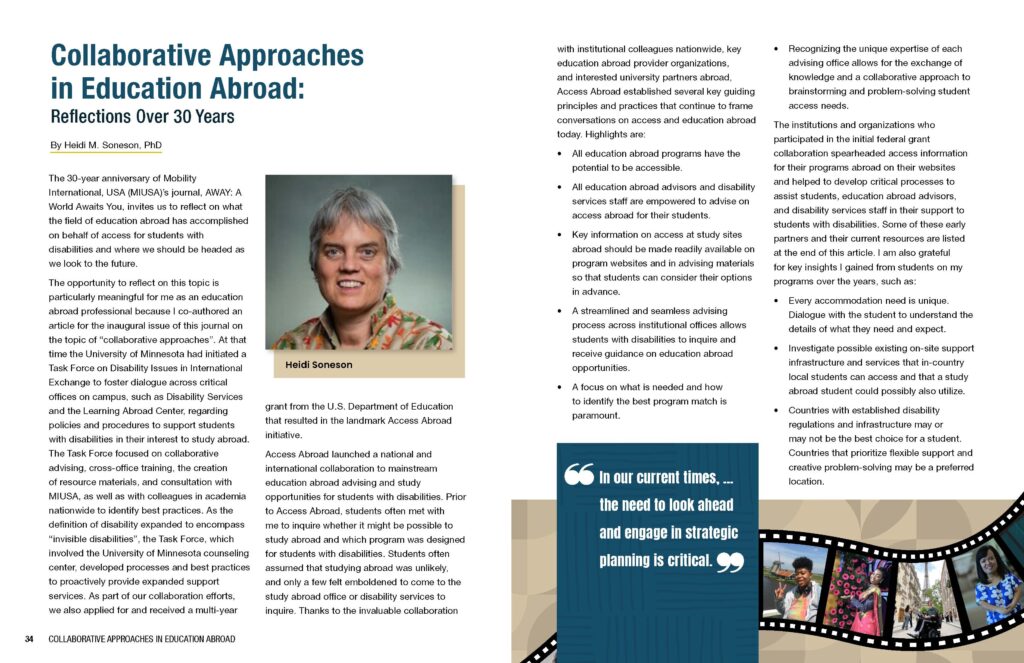
The 30-year anniversary of Mobility International, USA (MIUSA)’s journal, AWAY: A World Awaits You, invites us to reflect on what the field of education abroad has accomplished on behalf of access for students with disabilities and where we should be headed as we look to the future.
The opportunity to reflect on this topic is particularly meaningful for me as an education abroad professional because I co-authored an article for the inaugural issue of this journal on the topic of “collaborative approaches”. At that time the University of Minnesota had initiated a Task Force on Disability Issues in International Exchange to foster dialogue across critical offices on campus, such as Disability Services and the Learning Abroad Center, regarding policies and procedures to support students with disabilities in their interest to study abroad.
The Task Force focused on collaborative advising, cross-office training, the creation of resource materials, and consultation with MIUSA, as well as with colleagues in academia nationwide to identify best practices. As the definition of disability expanded to encompass “invisible disabilities”, the Task Force, which involved the University of Minnesota counseling center, developed processes and best practices to proactively provide expanded support services. As part of our collaboration efforts, we also applied for and received a multi-year grant from the U.S. Department of Education that resulted in the landmark Access Abroad initiative.
Access Abroad launched a national and international collaboration to mainstream education abroad advising and study opportunities for students with disabilities. Prior to Access Abroad, students often met with me to inquire whether it might be possible to study abroad and which program was designed for students with disabilities. Students often assumed that studying abroad was unlikely, and only a few felt emboldened to come to the study abroad office or disability services to inquire.
Guiding Principles from Education Abroad Colleagues
Thanks to the invaluable collaboration with institutional colleagues nationwide, key education abroad provider organizations, and interested university partners abroad, Access Abroad established several key guiding principles and practices that continue to frame conversations on access and education abroad today. Highlights are:
- All education abroad programs have the potential to be accessible.
- All education abroad advisors and disability services staff are empowered to advise on access abroad for their students.
- Key information on access at study sites abroad should be made readily available on program websites and in advising materials so that students can consider their options in advance.
- A streamlined and seamless advising process across institutional offices allows students with disabilities to inquire and receive guidance on education abroad opportunities.
- A focus on what is needed and how to identify the best program match is paramount.
- Recognizing the unique expertise of each advising office allows for the exchange of knowledge and a collaborative approach to brainstorming and problem-solving student access needs.
Key Insights from Students
The institutions and organizations who participated in the initial federal grant collaboration spearheaded access information for their programs abroad on their websites and helped to develop critical processes to assist students, education abroad advisors, and disability services staff in their support to students with disabilities. Some of these early partners and their current resources are listed at the end of this article. I am also grateful for key insights I gained from students on my programs over the years, such as:
- Every accommodation need is unique. Dialogue with the student to understand the details of what they need and expect.
- Investigate possible existing on-site support infrastructure and services that in-country local students can access and that a study abroad student could possibly also utilize.
- Countries with established disability regulations and infrastructure may or may not be the best choice for a student. Countries that prioritize flexible support and creative problem-solving may be a preferred location.
- Engage the student in the dialogue regarding possible accommodations abroad as well as cultural differences between what the student has come to expect on a US campus versus what they will experience abroad.
Future Goals and Priorities
In our current times, with diminishing federal funding for support services and organizations such as MIUSA, the need to look ahead and engage in strategic planning is critical. I conferred recently with Roberta (Bobbi) Cordano, President of Gallaudet University and previously Director of Disability Services at the University of Minnesota, about our future goals and priorities.
We identified the following:
- Each institution and organization involved with education abroad will need to make it a priority to carry forward the guiding principles that organizations such as MIUSA and initiatives such as Access Abroad have established and published.
- Establish and foster the kind of task force mentioned in this article or other similar initiatives to continue the dialogue and collaboration on your own campus that allows for cohesive student advising to consider and support all student needs.
- Engage faculty who lead your programs abroad to assist in investigating access at the overseas study location. When faculty with disabilities lead programs abroad, seek their insights to document in your program materials to assist future student participants. Their own experiences can be helpful for future advising.
- The community of knowledgeable colleagues is now much wider. Utilize conferences and outreach options such as the SECUSS-L listserv and NAFSA’s EA Knowledge Community listserv to seek advice and inquire about best practices.
- The range and type of education abroad programs have grown significantly over the last decades. Ensure that your institutional education abroad portfolio has short and long-term programs, faculty-directed as well as center-based and integrated options, a range of geographical locations, direct enrollment and consortium or provider options. This range of options and types of potential support abroad benefits students with disabilities and the entire campus population.
- Invite all students through program and advising meeting evaluations to share what kinds of support and services would facilitate education abroad for them. This entails access to your office, your education abroad information materials, and program support abroad. The more we can plan ahead, the more successful we will be in achieving our goal to enrich student lives through education abroad.
- Finally, emphasize “human-centered design” – an approach to advising and programming that emphasizes and embraces the variety of human experiences that constitutes student life and learning and that enables meaningful, responsible participation of all students in international programs. Whether there is a short-term accommodation need or a comprehensive access investment, education abroad advising and programming will succeed for the greatest number of students if we proactively establish and foster a multifaceted approach to our student outreach and support.
As we look ahead to what the future will hold, I hope that we can come together again in another 30 years (approximately) and revisit our experiences and refine our goals for the benefit of all our students. I hope to see you then! ■
Sample Resources
Access Abroad
Site-specific Accessibility Categories
Mobility International USA
Gallaudet University Human-Center Design in London
IES Student Resources
IFSA-Bulter Student StoriesThis article is part of the AWAY Journal – NCDE’s 30th Anniversary Issue